Your GLP-1 Consumers Are Talking. Here's the Data Layer Your Team Is Missing.


The GLP-1 category has done something rare in pharma: it turned consumers into public advocates, skeptics, and storytellers, all at once.
Across message boards, health forums, and telehealth review pages, millions of people share firsthand accounts of their weight management journeys in real time. They’re comparing branded versus compounded options, debating cost and access, and describing what it’s like to switch brands and adjust administration. And they're doing it publicly, in their own words, every single day.
For DTC pharma marketers, this should be the most valuable signal in the market. But most teams can't access it.
The intelligence gap in DTC pharma
DTC pharma is experiencing a paradox. Ad spend is surging — healthcare and pharma digital advertising reached nearly $25 billion in 2025, up over 13% year-over-year, and GLP-1 brands like Wegovy and Zepbound are among the category's biggest spenders. Companies like Eli Lilly, Novo Nordisk, Hims & Hers, and Ro are investing heavily in platforms that put them directly in front of consumers.
But the intelligence powering those campaigns hasn't kept pace. Most pharma marketing teams still rely on a patchwork of tools that each solve part of the puzzle while missing the bigger picture. Brand tracking surveys run six to eight weeks behind real-time conversation. Social listening platforms like Brandwatch or Sprinklr offer dashboard-level summaries but lock the underlying data behind APIs and export limits. IQVIA and Komodo Health measure prescription activity but not the upstream sentiment that drives it. And none of these tools talk to each other inside the data environment where pharma teams increasingly do their actual work.
The result: a Head of Marketing spending $20 million or more on digital campaigns has no reliable way to measure whether patient conversations shifted in tone or volume after a campaign launched. Return on ad spend stays a channel-level metric when it should be informed by how real consumers talk about the brand across communities. And a VP Digital building AI-powered personalization has no clean way to feed authentic consumer language into the models that power it.
That's the gap.... and it's widening precisely at the moment when DTC pharma needs that signal most.
Why this moment is different?
Several forces are converging to make this intelligence gap untenable.
The GLP-1 market is moving faster than traditional research can track.
In 2026, DTC access to GLP-1 therapies continues to expand. Manufacturers are offering direct pharmacy programs, oral formulations like the Wegovy pill are reaching consumers, and new pricing structures are reshaping how patients access treatment. The conversation around these therapies shifts as new access programs launch, coverage policies change, and consumer experiences accumulate across platforms. A brand study fielded in January is outdated by March.
FDA enforcement of DTC advertising just escalated.
In September 2025, the FDA announced sweeping reforms targeting misleading direct-to-consumer drug ads. The agency sent thousands of warning letters to pharmaceutical companies, issued roughly 100 cease-and-desist orders to companies with deceptive ads, and initiated rulemaking to close the "adequate provision" loophole that had allowed companies to minimize safety disclosures in broadcast and digital advertising since 1997. The FDA also flagged the rise of undisclosed paid influencer promotion, noting that the line between editorial content, user-generated media, and pharmaceutical advertising has blurred. For marketing leaders, every campaign decision now carries more compliance risk, and the cost of being misaligned with how consumers actually perceive your brand is higher than ever. You need to know what consumers are saying, not what your last focus group told you.
Pharma companies have already invested in the data infrastructure to do this right.
Snowflake is increasingly the backbone of healthcare data strategy. According to Snowflake's own 2026 research, 85% of healthcare leaders say that improving data interoperability has become a higher priority over the past two years as they scale AI, and 77% of healthcare organizations have already invested or plan to invest in generative or agentic AI. Major pharma and healthcare companies (including CVS Health, Pfizer, and others) are running analytics, ML workflows, and AI initiatives on Snowflake. The missing ingredient isn't compute power or analyst headcount. It's the right data layer.
What "the right data layer" looks like in practice
This is where the conversation shifts from a problem statement to an architecture decision.
The traditional approach to consumer intelligence in pharma has been to buy a SaaS platform, point it at a set of keywords, and read the dashboards. That model worked when social data was supplementary, a complement alongside primary research. But in a DTC world where online conversation is the market signal, dashboards aren't enough. Marketing teams need the raw data inside their analytics stack, where it can be queried, blended with other datasets, and fed into AI models.
That's the model Socialgist was built for. Rather than offering another dashboard, Socialgist delivers the world's largest collection of public human conversation — from forums, communities, video platforms, and review sites — as structured, AI-ready datasets directly inside Snowflake.
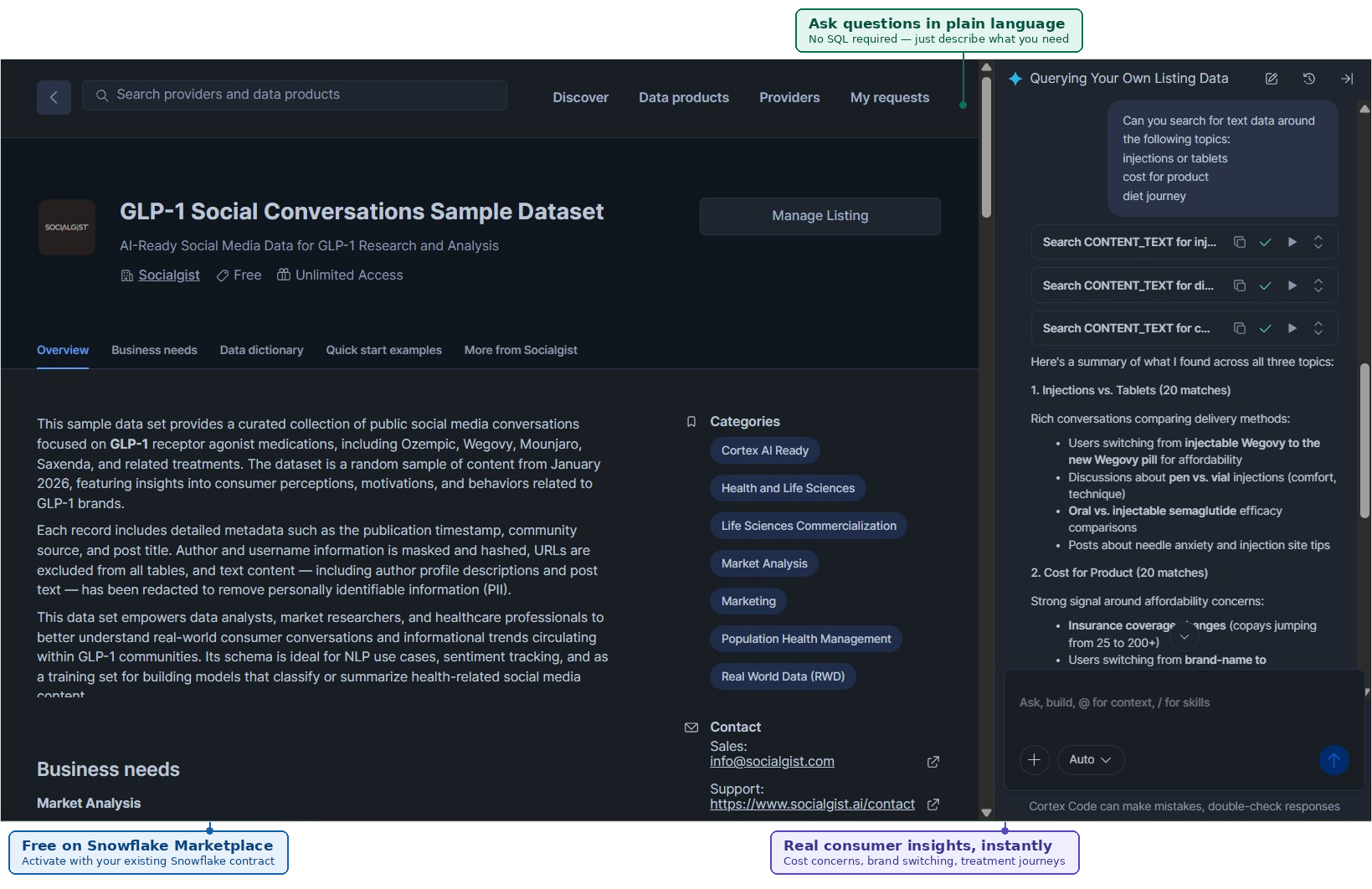
To make this concrete: Socialgist recently published a GLP-1 Social Conversations sample dataset on the Snowflake Marketplace. It's a purpose-built dataset for Life Sciences teams that includes:
- Full thread hierarchy: Posts, comments, and replies captured with parent-child relationships intact, so analysis can happen at the individual post level or rolled up to the full conversation
- AI-ready text: Content pre-chunked for use with large language models, enabling sentiment analysis, theme extraction, and semantic search without additional preprocessing
- Author context: Anonymized author profiles with platform affiliation and self-described bios, enabling segmentation by community type while maintaining full privacy compliance
- Privacy by design: All PII is redacted, author display names are hashed, URLs are stripped, and platform-specific identifiers are masked
The data is immediately queryable alongside whatever else your team already has in Snowflake.
The practical difference this creates for a Head of Marketing is significant. Instead of waiting for a social listening vendor to surface a trend in a dashboard, your data science team can run sentiment analysis across GLP-1 conversations and correlate it with internal campaign performance data, connecting consumer voice to actual return on ad spend. Instead of commissioning an agency to do a quarterly brand perception study, you can monitor brand conversation volume and competitive share of voice continuously. And instead of wondering whether your D2C messaging resonates with consumers, you can see in their own language how they describe their experience with your product versus the alternatives.
For a VP Digital or Head of Data, the value is different but equally direct. Consumer conversation data that arrives structured and pre-chunked for LLMs can be used for retrieval-augmented generation (RAG), grounding AI models in authentic consumer language rather than recycled training data or generic web content. That means your personalization engines, chatbots, and content recommendation systems can draw on how real people talk about GLP-1 therapies, not how your marketing team assumes they do.
The shift from tools to infrastructure
There's a broader pattern here that extends beyond any single dataset or vendor. The most advanced pharma marketing organizations are moving away from point solutions and toward a composable intelligence stack, one where the data layer, the analysis layer, and the infrastructure layer are each best-in-class and modular.
In this model, Socialgist provides the raw conversational data. AI partners — whether internal data science teams, specialized NLP providers, or Snowflake's own Cortex AI — provide the analysis. And Snowflake provides the governed environment where everything converges. The result is an intelligence capability that no single SaaS tool can match: real-time, blendable, scalable, and fully owned by the brand.
For DTC pharma, where the race for consumer attention is increasingly decided by who understands the conversation fastest, this isn't a future-state infrastructure project. It's a competitive advantage available today.
Getting started
The GLP-1 Social Conversations sample dataset is available now on the Snowflake Marketplace. If your organization is already on Snowflake, there's nothing to install or integrate; get the dataset and query today.
→ Query the GLP-1 sample dataset on Snowflake
For teams that want to go deeper – expanded datasets, custom topic configurations, or ongoing data delivery – contact us
Citations:
- US Healthcare and Pharma Ad Spending 2025. eMarketer. October 31, 2025. https://www.emarketer.com/content/us-healthcare-pharma-ad-spending-2025
- AbbVie's Skyrizi, Novo's Wegovy duke it out in Q2 TV ad spending totals. Fierce Pharma. July 16, 2025. https://www.fiercepharma.com/marketing/abbvies-skyrizi-novos-wegovy-duke-it-out-q2-tv-ad-spending-totals
- 5 Projected GLP-1 Trends in 2026. GoodRx. February 5, 2026. https://www.goodrx.com/classes/glp-1-agonists/glp-1-trends
- FDA Launches Crackdown on Deceptive Drug Advertising. FDA. September 9, 2025. https://www.fda.gov/news-events/press-announcements/fda-launches-crackdown-deceptive-drug-advertising
- Life Sciences and Direct-to-Consumer Television Advertising: An Update on Industry Utilization. IQVIA. October 2025. https://www.iqvia.com/locations/united-states/blogs/2025/10/life-science-and-direct-to-consumer-television-advertising
- Snowflake Research Reveals 85% of Healthcare Leaders View Interoperability as Foundational to Scaling AI. Snowflake/Hakkoda. March 10, 2026. https://www.snowflake.com/en/news/press-releases/snowflake-research-reveals-85-percent-of-healthcare-leaders-view-interoperability-as-foundational-to-scaling-ai/
- What Companies Use Snowflake in 2026? Pleasant Data. 2026. https://pleasantdata.com/what-companies-use-snowflake/